What makes us different

Excellence and Authenticity

Food safety is ensured throughout the entire supply chain through the implementation, rigorous application, and continuous improvement of a Food Safety Management System and manufacturing processes.

Certification under a management system is an effective way to guarantee that you consume high-quality olive oil with reliable traceability, fully meeting consumer expectations.

olivna certif diwan al iftaa

Certification Hlal

olivna certif ccpb

Certification ccpb

olivna certif usda organic

Certification usda organique

olivna certif biologique

Certification biologique

olivna certif fssc

Certification fssc 22000

olivna certif brc food

Certification brc food

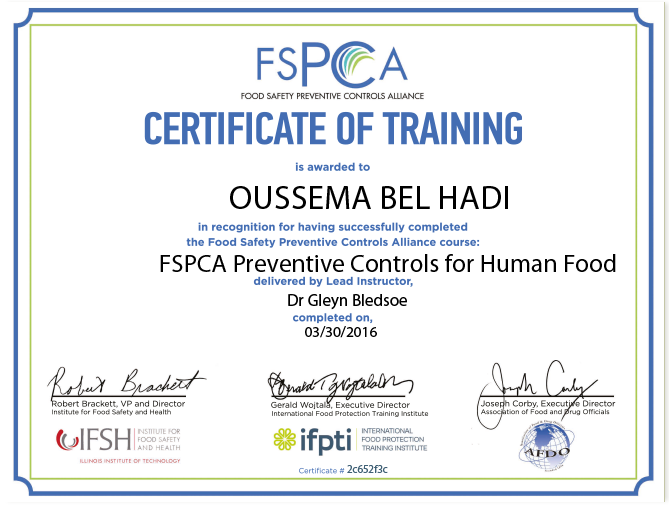
FSPCA Certification: A Guarantee of Food Safety

Our factory is FSPCA (Food Safety Preventive Controls Alliance) certified, an international standard that demonstrates our expertise in good manufacturing practices and food safety. This certification strengthens the confidence of our partners and customers by ensuring olive oil that meets the highest standards of the U.S. and global markets.

Production

Picking

Olive harvesting generally takes place from the end of October through January. The fruits are hand-picked to ensure a plentiful harvest of the highest quality.

Extraction

The olives are transported immediately after harvest for cold-press extraction. We ensure that the olives are stored under optimal conditions and that processing takes place on the same day, within the shortest possible timeframe. A preliminary check of yield and quality is carried out on olive samples, in accordance with good manufacturing practices and hygiene standards.

Presse à olives

Oil Storage

Our olive oil is stored in stainless steel tanks, protected from light and kept at carefully controlled temperatures, with nitrogen injection to maintain its stability.

The transport and storage of the oils are carried out under the supervision of our Quality Department and our analytical laboratory.

Every step in the production of the oil—from olive harvesting to bottling—is subject to strict traceability.

Olivna Huiles d’olive tunisiennes

Bottling

The packaging and bottling of olive oil is carried out using various types of containers: glass bottles, PET bottles, metal tins, and bag-in-box packaging.

The bottling process involves several steps:**

  • Inspection upon receipt and sampling (oil and packaging materials)

  • Storage

  • Olive oil filtration

  • Storage of olive oil in tanks

  • Bottling

  • Analysis, fill level control, and foreign object detection

  • Cartoning

  • Palletizing and storage